




What is a medical aid shortfall, and why does it happen?
Published by GapCover. Administered by GapRisk Administrators (Pty) Ltd (Reg. No. 2021/500446/07), an authorised financial services provider, FSP 51758. Underwritten by Western National Insurance Company Ltd (Reg. No. 2005/017349/06), a juristic representative under FSP 9465. | Last updated: 26 October 2026
The short answer
A medical aid shortfall is the part of a medical bill your scheme does not pay, because the provider charged more than the scheme’s rate for that procedure. It is common, and it is usually not a mistake. Your scheme pays at the rate it sets, specialists set their own fees, and the provider bills you for the difference. You are liable for it, even when your scheme confirmed the procedure was covered.
What a medical aid shortfall is
Definition
A medical aid shortfall, also called a tariff shortfall, is the difference between what a healthcare provider charges for a treatment and what your medical scheme pays at its own rate. You are liable for the balance.
On a scheme statement it may appear as a shortfall, the member portion or an amount due by the member. The provider then bills you for it directly, usually after you have been discharged.
Why the gap exists
Definition
Medical Scheme Tariff: the rate your medical scheme sets for a procedure. Specialists price independently and are not bound by it, so the difference between the two is a shortfall you are liable for.
Your medical scheme sets a rate for every procedure code and pays claims against it. Depending on your option, it pays at 100% of that rate or at a higher multiple, such as 200%.
Specialists are not bound by that rate. There is no fee schedule that private specialists in South Africa are required to follow, so each one sets their own fee. Where that fee is higher than what your scheme pays, the difference is a shortfall.
This is how private healthcare pricing is structured. It is not your scheme failing to pay what it promised. When a scheme confirms a procedure is covered, it is confirming that it will pay its rate, not the full fee any provider chooses to charge. Two members on the same option, having the same procedure, can face very different shortfalls depending on which specialists treat them.
What a shortfall looks like in rands
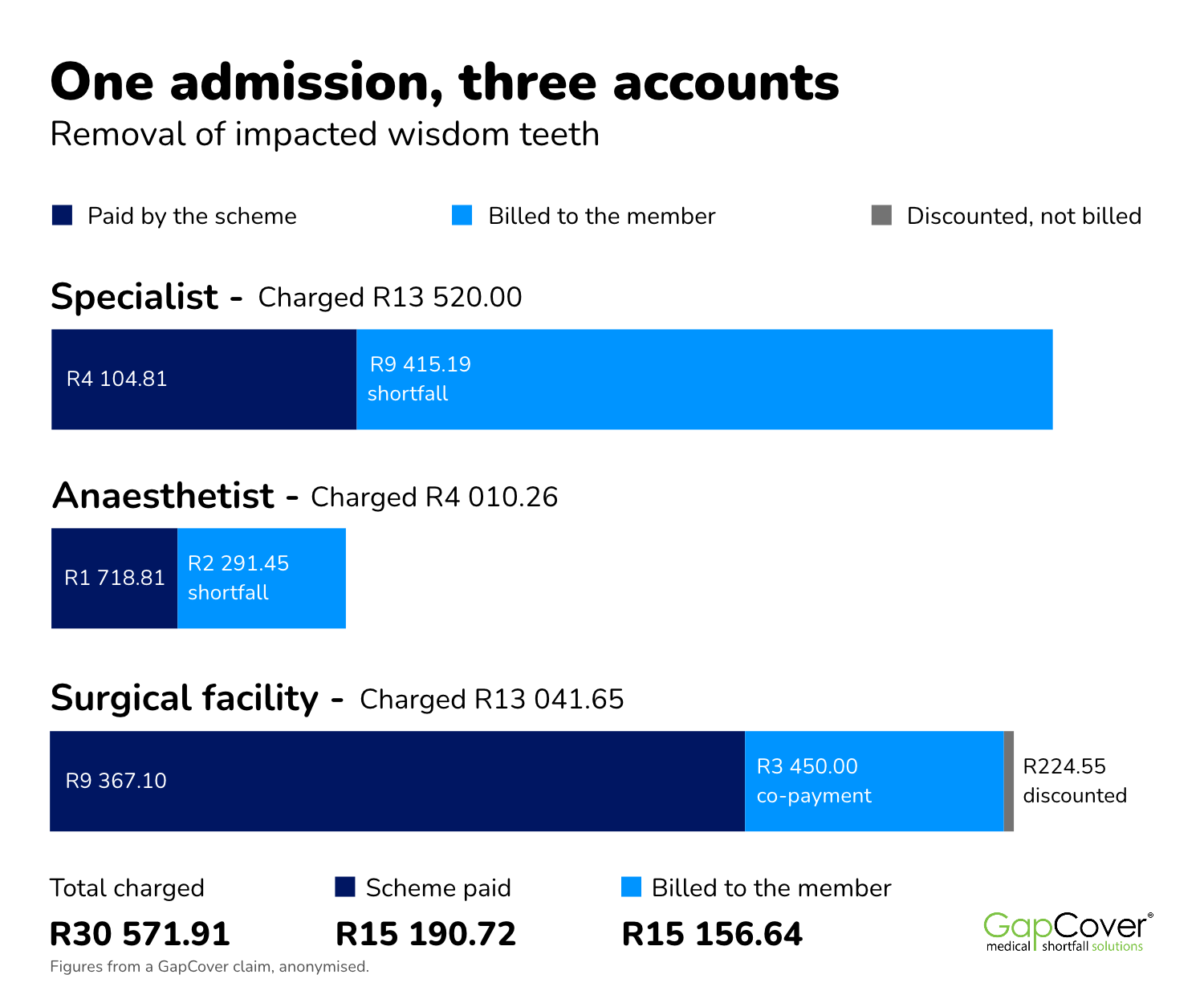
One GapCover member’s admission for the removal of impacted wisdom teeth produced three separate accounts: one from the specialist, one from the anaesthetist and one from the surgical facility.
Worked example: one admission, three accounts
| Account | Charged | Scheme paid | Billed to the member |
|---|---|---|---|
| Specialist | R13 520.00 | R4 104.81 | R9 415.19 (shortfall) |
| Anaesthetist | R4 010.26 | R1 718.81 | R2 291.45 (shortfall) |
| Surgical facility | R13 041.65 | R9 367.10 | R3 450.00 (co-payment) |
| Total | R30 571.91 | R15 190.72 | R15 156.64 |
Figures from a GapCover claim, anonymised. A further R224.55 on the facility account was discounted and not billed to the member.
The scheme paid R15 190.72 of a R30 571.91 bill, just under half. Most of the balance came from the specialist, whose fee was more than three times what the scheme paid. Two of the three balances are shortfalls. The third is a co-payment, which is a different charge, explained in the questions below.
Where shortfalls hit hardest
Anaesthetists
You rarely choose your anaesthetist, and you often meet them on the day. They bill separately from the hospital and the surgeon, so theirs is the account members least expect.
Assistant surgeons
Some procedures need an assistant surgeon, who sends a separate account. Many members only find out there was one when that account arrives.
Several specialists on one procedure
One admission can involve a surgeon, an anaesthetist, an assistant, a physician and a radiologist. Each bills separately at their own fee, and each can leave a shortfall.
Procedures in the doctor’s rooms
Scopes and minor procedures done in a doctor’s rooms rather than a hospital still carry a specialist fee, and that fee can sit above the scheme rate in exactly the same way.
What you can do about it
There are three ways to reduce or manage a shortfall, and they can be combined.

1. Ask for quotes before a planned procedure
Ask every provider involved for a quote before you are admitted, then ask your scheme what it will pay on the same codes. The difference is your likely shortfall. Five questions cover it:
- Which specialists will be involved, including an anaesthetist or an assistant?
- Which procedure codes will each of them bill?
- What will each charge, in rands or as a percentage of Medical Scheme Tariff?
- What will my scheme pay on those codes, on my option?
- Does my scheme apply a co-payment to this procedure or this hospital?
2. Use specialists who have an arrangement with your scheme
Many schemes have network or contracted specialists who agree to charge at the scheme rate or within an agreed limit. Using them can reduce the shortfall or remove it. Ask your scheme for its list before you book, and check the anaesthetist separately, because an arrangement with your surgeon does not extend to them.
3. Hold gap cover alongside your medical scheme
Gap cover is an insurance policy that pays towards shortfalls, up to a set percentage of Medical Scheme Tariff and within annual limits. It is not a medical scheme and does not replace one. You need to belong to a medical scheme to hold it, and it pays towards the balance after your scheme has paid its share. Limits, exclusions and waiting periods differ between options and between providers, and every policy caps what it will pay. Whether it suits you depends on your scheme option and what you are likely to need.
For how the four GapCover options differ on shortfall and co-payment cover, see GapCover Primary, Combined Cover and Elite: what actually differs.
Frequently asked questions
What does shortfall mean on a medical aid statement?
A shortfall is the part of a provider’s account your scheme did not pay, because the fee was higher than the scheme’s rate for that procedure. It may appear as a shortfall, member portion or amount due by the member. The provider bills you for it directly, and you are liable for it.
Why did I get a separate invoice from the anaesthetist after my hospital stay?
Anaesthetists are independent specialists who bill separately from the hospital and the surgeon. Your hospital account covers the ward, theatre and medicines, not the specialists who treated you. If the anaesthetist charges above your scheme’s rate, their invoice will include a shortfall, and it often arrives after you have been discharged.
My scheme said the procedure was covered. Why do I still have a bill?
Covered means your scheme pays its rate for the procedure, not every fee a provider charges. Specialists can charge above that rate, and the difference comes to you. Check your statement for the codes billed and what the scheme paid. If you think a claim was paid at the wrong rate, or it relates to a Prescribed Minimum Benefit and you used your scheme’s designated service provider, query it with your scheme first. If the balance stands, ask the provider about a reduction or a payment plan.
What does 100% of scheme tariff mean?
It means your scheme pays the full rate it has set for a procedure, and nothing above it. If a specialist charges twice that rate, a scheme paying at 100% covers half the fee and the other half is a shortfall. Options that pay at a higher multiple, such as 200%, narrow the gap but do not close it when fees run higher still.
Is a shortfall the same as a co-payment?
No. A shortfall is the difference between a provider’s fee and your scheme’s rate. A co-payment is a fixed amount or percentage your scheme requires you to pay towards certain procedures, hospitals or scans, regardless of what the provider charges. One admission can produce both. GapCover’s options differ on co-payment cover, and the plan comparison sets out which ones include it.
Working out what you are exposed to
Start with your scheme’s benefit schedule: the rate it pays at, and the co-payments it applies. That tells you where a shortfall can arise. To see how the four GapCover options compare, read GapCover Primary, Combined Cover and Elite: what actually differs. If you already have a shortfall to claim, our step-by-step claims guide sets out the process. If you want a figure, request a quote and an advisor will work through the options with you.
GapCover isn’t a medical scheme, and the cover isn’t the same as that of a medical scheme. Membership isn’t a substitute for a medical scheme membership. Terms and Conditions Apply.