




01 Jun The anaesthetist bill nobody warned you about
Picture this: you had a procedure done at a private hospital. Your medical aid approved it in advance. The surgeon was covered. The hospital was in-network. You walked out feeling like you’d done everything right.
Then, three weeks later, a bill arrives. Not from the hospital. From the anaesthetist.
This happens to South Africans every day, across routine procedures, pre-approved operations, and surgeries that went perfectly. The anaesthetist shortfall is one of the most common and least-discussed gaps in private healthcare cover, and most people only find out about it after the bill has arrived. So, let’s go over it.
Your medical aid approved the procedure. So, why is there still a bill?
Medical aid approval sounds like a green light for everything. The downside? It isn’t.
When your scheme approves a procedure, it’s confirming that the procedure is covered at its own rate. That means if doctors and professionals charge more than what the medical scheme has decided it will pay, the difference lands with you. So, what your medical aid is not doing is agreeing to pay every professional involved at whatever rate they charge. Your approval typically covers the hospital facility costs and, in many cases, the surgeon. The anaesthetist is a different story.
Anaesthetists are independent practitioners. They run their own practices, set their own fees, and send their own invoices, separately from the hospital and the surgeon. Your medical aid will pay the anaesthetist’s bill according to its own rate, which is tied to a benchmark called the Medical Scheme Tariff (MST). But the anaesthetist’s actual fee is often significantly higher than what the scheme is prepared to pay.

The part most people don’t know is you can’t choose your anaesthetist
Here’s what makes this especially frustrating. In most theatre procedures, you don’t select your anaesthetist. Your surgeon does. You typically meet the anaesthetist briefly before the operation, and by that point, there’s no meaningful opportunity to discuss their fees or shop around.
You had no say in who was appointed. You had no upfront cost estimate. And yet, weeks later, you’re receiving their invoice.
This is standard practice in private healthcare settings in South Africa. Anaesthetists are assigned based on availability, hospital systems, and surgical team preferences. Billing follows later, directly to the patient.
So how does the anaesthetist set their fee?
Anaesthetic fees aren’t flat charges. They are built from several components:
- A pre-operative assessment
- A procedure-specific fee
- Theatre time charge
This rate set by each anaesthetist doesn’t have to align with what your medical aid pays. Some practitioners charge at rates well above what the medical aid pays and legally, they can. Specialists across private healthcare in South Africa can charge up to 500% of the medical aid rate, meaning you pay five times what the medical scheme covers, though most anaesthetists operate significantly below that ceiling. However, even a charge at 200% can leave a meaningful shortfall.
What the shortfall can actually look like, in rands
Here’s where it gets concrete. These are real claims processed and paid by GapCover during April 2026:
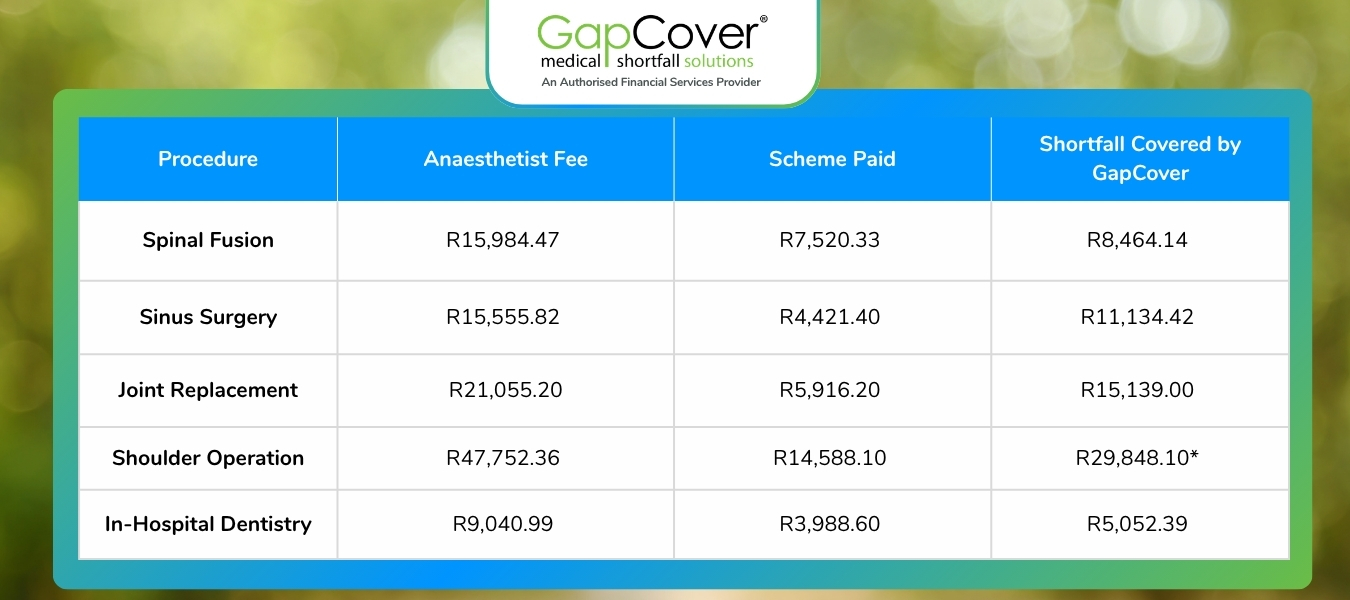 *A discount of R3,316.16 was received from the practice for direct payment. Source: GapCover claims, April 2026. All figures factual and approved for publication.
Look at the sinus surgery. Most people would think of that as a routine, fairly minor procedure. The anaesthetist charged R15,555.82. The medical aid paid R4,421.40. That left a patient facing an anaesthetist shortfall of over R11,000 out of their own pocket, on a procedure they’d have considered straightforward.
The shoulder operation shows just how significant the exposure can be. Nearly R48,000 for the anaesthetist alone, with the scheme covering less than a third.
These are typical claims South Africans face daily.
Which procedures carry the highest risk of an anaesthetist shortfall?
Any procedure that takes place in theatre with anaesthetic involvement carries exposure to an anaesthetist shortfall. That includes:
- Joint replacements (hips, knees, shoulders)
- Spinal procedures (fusions, disc surgery, decompressions)
- Caesarean sections
- Appendectomies and abdominal procedures
- Sinus, ear, nose and throat surgery
- Dental procedures under general anaesthetic
- Cardiac and vascular procedures
The higher the complexity and the longer the theatre time, the larger the anaesthetic fee is likely to be. A twenty-minute procedure carries a different risk profile from a three-hour spinal fusion. But even shorter procedures, as the sinus surgery data shows, can produce an anaesthetist shortfall that runs into five figures.
The procedures you’d consider routine, the knee scope, the wisdom teeth under general anaesthetic, the hernia repair, aren’t spared from the cost. The anaesthetist’s bill will arrive regardless.

This is exactly what gap cover was designed for
GapCover exists specifically to protect you against in-hospital shortfalls like these. It sits between what your medical aid pays and what the specialist charges for in-hospital procedures, picking up the difference so you’re not left with a bill you weren’t expecting and didn’t budget for.
When an anaesthetist charges above the scheme rate, GapCover settles the difference directly with the practice. The sinus surgery patient in the table above walked away without paying that R11,134 personally. The joint replacement patient didn’t have to find R15,139 from savings. Gap cover converted an unexpected expense into a covered claim.
It’s worth knowing that gap cover is a separate product from your medical aid, it runs alongside your existing scheme, not instead of it. Most people find it’s more accessible than they expected, both in terms of how it works and what it costs.
Now you know, here’s what to do
Understanding the anaesthetist billing gap is the first step. The second is making sure you’re protected before you need it, not after the bill arrives.
If you have medical aid and you’d be exposed to out-of-pocket costs from in-hospital specialists gap cover is worth looking into.
Get a quote from GapCover and find out what it would cost to close that gap. The conversation takes a few minutes. The protection lasts every time you step into a theatre.